AI Configurator and 3D design
← All projectsTBXS AI Configurator & 3D Designer
1
Set of rules for the designer and the AI agent
1
Set of rules for the designer and the AI agent
- ClientTHEBOXSYSTEM
- Year2026
- StatusIn development
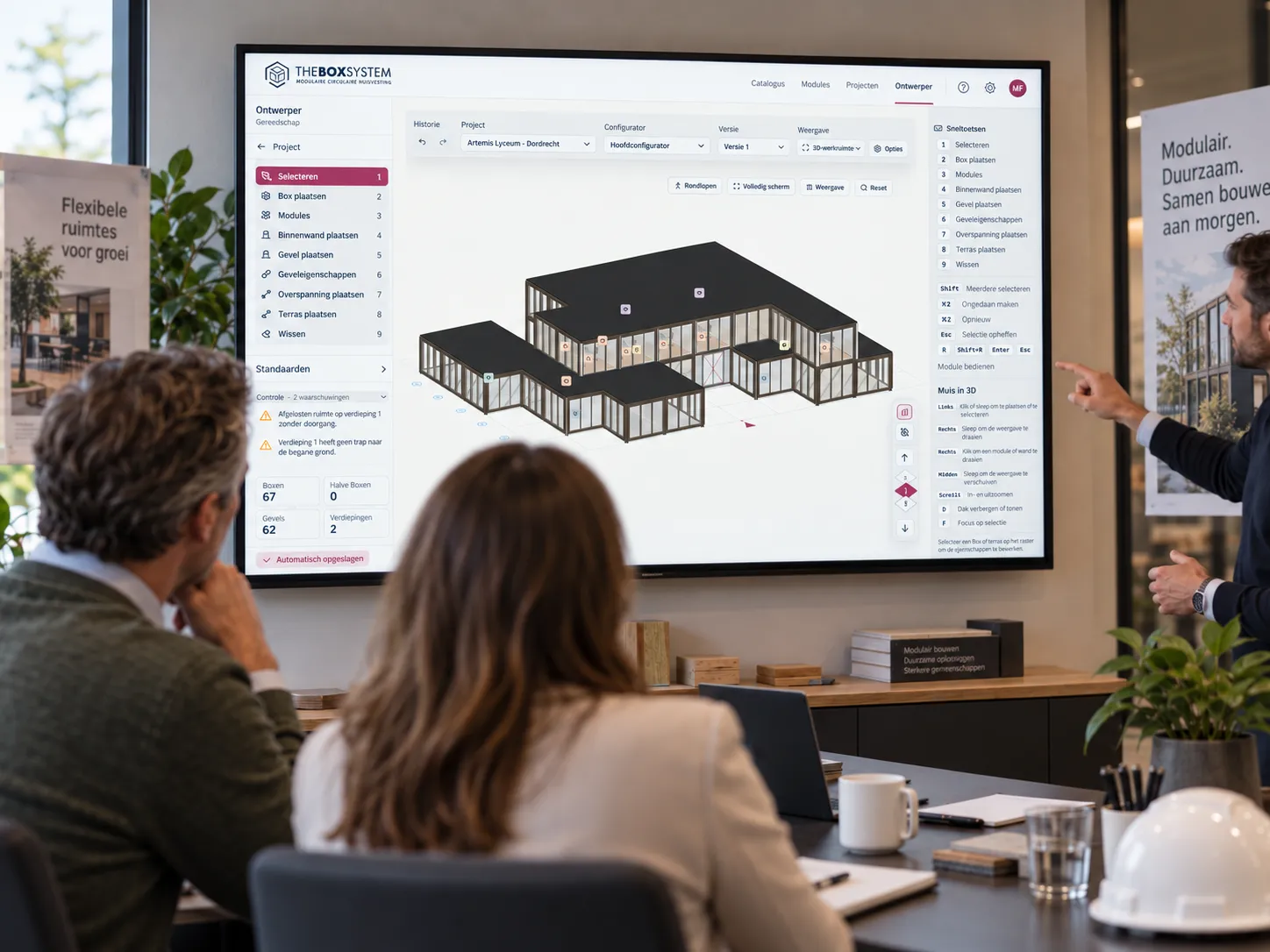
A design and quotation platform for modular school construction: design buildings in 3D, price them on the spot and deliver them as a quote. With an AI agent that puts buildings together itself, following the same rules as the designer.
From drawing to quote in one system
THEBOXSYSTEM builds modular, circular buildings from standardised boxes of 3.6 by 3.6 metres: buildings that can grow and be reused. A building consists of dozens of boxes, facades, interior walls, spans and terraces across several floors. Every change to the design affects the quantities, the price, the foundation and, in the end, the quote.
The platform brings that entire process together. A project starts in the designer, where the building is put together in 3D from boxes and ready-made modules such as a classroom, a learning plaza or a toilet block. While the design takes shape, the system calculates along: quote lines follow from the design, tiered prices and foundation phases are applied and the totals are ready straight away. One click produces a formatted quote as a PDF.
The language model proposes, the rules judge and the code calculates.
The challenge
Designing a modular building is a puzzle with strict rules. A classroom belongs on a facade, a staircase has to make every floor reachable and a building without an entrance is no building. The platform had to capture that knowledge without boxing the designer in:
- A 3D editor that works as fast as sketching on paper. Placing boxes, rotating modules, adding facades and interior walls, on any floor. Without slow menus, with keyboard shortcuts and instant visual feedback.
- Prices that always match the drawing. Every box, facade and module affects the quote. The calculation has to handle tiered prices, foundation phases, indicative and fixed prices and VAT, and old quotes must not change when the catalogue is updated.
- Building rules that advise instead of block. Which modules may sit side by side, which side faces the facade and whether the building works as a whole: all of it is checked, but the design is never held back.
- An AI that designs within those rules. A language model that can put a building together from plain language, without guessing coordinates or breaking rules.
A 3D editor that feels like a game
The designer is a full 3D workspace, built on Three.js. Everything that can be done in 2D can be done in 3D, on every floor:
- Keyboard first. The tools sit under the number keys 1 to 9, R rotates a module, H lifts the roof off to see the floor below and F zooms to the selection. Undo and redo work as expected.
- Instant feedback. A ghost follows the mouse: blue when a spot is free, orange when something will be replaced and red when it can’t be done, with the reason shown.
- Subtle animations. New boxes drop into place, facades grow up out of the floor and the roof settles on last. Large changes skip the animation, and anyone who prefers less motion gets calm transitions.
- Walking through the building. A first-person mode at eye level, with WASD and the mouse. A design can be experienced before anything is built.
- Built for large designs. Parts are cleverly reused and the rendering scales along, so large buildings stay smooth too.
The editor is still being extended, with more of that game-like feel: designing should be intuitive and enjoyable.
An AI agent that builds along
The most forward-looking part is the AI agent. In a bar below the designer, the user types what is needed, for example “place four classrooms around a learning plaza”, and the agent gets to work. The user watches the building take shape live: module by module, box by box, with the same animations as manual design. The whole turn is a single undo step.
Behind that simplicity sits a deliberate architecture. The language model never calculates coordinates itself. It states what should go where and next to what, after which a calculation engine works through every possible position and rotation and picks the best. After each step the agent sees which issues were added or resolved, so it corrects its own mistakes.
- A rule system. Per module and per side, it is defined what must face the facade and which rooms must, may or must not sit next to it. On top of that, the system checks the building as a whole: stairs on every floor, no enclosed rooms and an entrance.
- Tagged building blocks. Modules have a room function, such as classroom, learning plaza, staff room or office, and tags that say which kind of project they fit. That way the agent knows a Montessori school needs different rooms than a Dalton school.
- A knowledge base. The people who know the trade capture what a good design is: when to use which module, what belongs next to it and which rules of thumb apply. Each module already carries instructions for designers and the AI in the application; a full knowledge base is on its way, managed without changing any code.
- The same rules for people and machines. The agent works through exactly the same functions as the designer. What the AI builds is checked, calculated and priced just like manual work.
The agent designs schools today. The goal is an agent that can put together any type of building, from schools to offices, based on a brief.
Where it stands
A working version is running and is now being tested and refined. At the same time, the platform keeps growing: the 3D editor is gaining more interaction, the AI agent is getting smarter with a knowledge base and more building expertise, and the rule system grows along with it.
The foundation makes that possible: hundreds of automated tests, a documented API and an architecture in which the language model is a setting, not a fixed choice. That way the best available AI can always be used, without rebuilding the platform.
Stack
Built with
- ReactFrontend
- Three.js3D editor
- TypeScriptLanguage
- FastifyAPI
- PostgreSQLDatabase
- Anthropic APIAI agent
- AzureCloud Infrastructure